Trading memecoins with a $10 bankroll beats waiting for a big stack because small size forces discipline and keeps fees visible
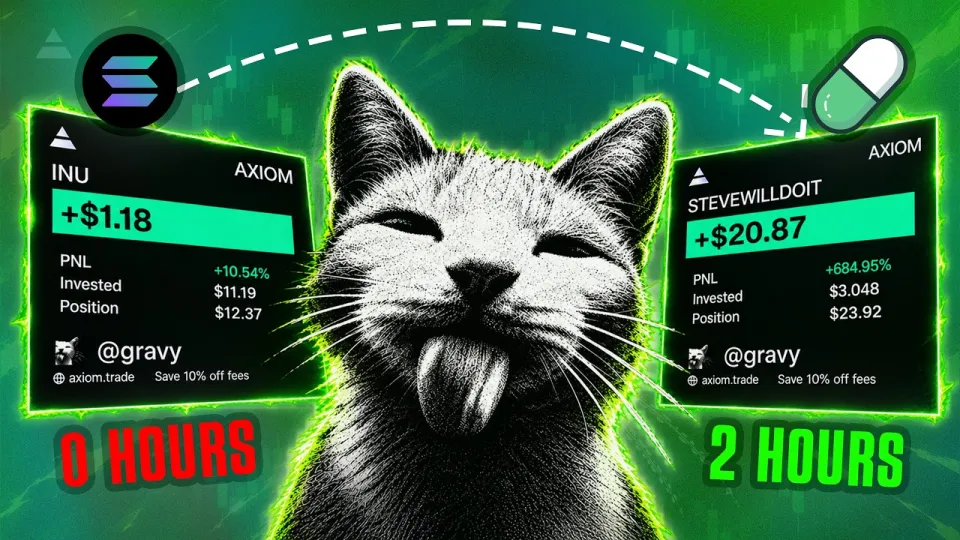
Video: I Tried Trading Memecoins with Just $10
You can order the same kind of articles for your own video to boost it on YouTube and Google. Just message the Telegram bot @sat_sit_bot. The bot writes and publishes the articles itself (with your YouTube video embedded) on popular topical websites (no ads). Try it free: 50 articles on us.
· based on the channel gravy
Meme coin trading with a small bankroll is possible — the catch is that position size, not talent, decides whether fees and slippage leave you anything. A $10 account can take five separate sub-0.05 SOL positions on Solana and still learn something real about narrative timing, exits and the cost of being late. The clearest public demonstration is the «gravy» experiment, where five buys were logged on Axiom, a Solana trading terminal that offers 2x cashback and 15% lower fees through the referral link.
Why a $10 meme coin portfolio is a test of fees, not of conviction
The real opponent of a small meme coin account is the cost stack: priority fees, platform fees, slippage on thin liquidity and the spread on the way out. On a $500 position a 2% round-trip cost is annoying; on a $10 position it can be 10–20% of the trade before the chart even moves. That is why the experiment capped every buy below 0.05 SOL — at Solana prices near $200 that is roughly $10 per entry, and it makes every fee line visible instead of hidden inside a large notional.
Three rules make a micro bankroll survivable:
- Size each entry so that fees plus expected slippage stay under about 5% of the position.
- Trade only pairs with enough liquidity that a $10 exit does not move the price.
- Treat the first five trades as tuition, not as a path to a life-changing return — the goal is a repeatable process, not a lottery ticket.
The five trades and what each one was actually betting on
The experiment was built around narratives rather than charts, and each ticker represented a different kind of bet. STEVEWILLDOIT was a personality-led play, the kind of coin that lives or dies on whether the character keeps posting. NPC rode the broader «NPC» meme format that circulates on Solana. MET was tied to Meteora, a real protocol name, which gives the token a reference point traders can search for. PUMPY the Trader was a meta-play on the pump.fun launch culture itself, and UNTXD was the late-cycle attempt where the entry logic was weakest.
The X Money coin meta that framed part of the session ran on e/acc and Cream narratives — ideological and community storytelling rather than revenue. That matters for anyone learning to trade memecoins: the question is never «is this useful», it is «who is talking about this right now and how long will they keep talking».
How to read a meme coin narrative before you buy
A meme coin narrative is a story with a shelf life, and the trade is about how much of that shelf life is left when you enter. Narratives spread through a small number of crypto accounts on X, then through Telegram and Discord groups, then through aggregators — and by the time an aggregator lists it, the first wave is usually selling into you. The most-liked question under the video said exactly this: finding coins with good narratives feels overwhelming, and buying the dip often means buying the exit liquidity.
A workable filter, in order:
- Identify the source of the story — a person, a protocol, a running joke. If you cannot name the source in one sentence, skip it.
- Check how old the story is. A narrative on day one behaves differently from the same narrative on day three.
- Look at who is still posting after the first 24 hours. Sustained posting is the closest thing to a durability signal.
- Decide your exit before entry: a fixed percentage, a market-cap level, or a time limit.
Position sizing, fees and the arithmetic of turning $10 into more
Turning $10 into a meaningful number requires either a large multiple or repeated small edges, and the second is far more realistic. A 2x on a $10 position is $10 of profit; five 30% wins with disciplined sizing compound faster than one hope-driven hold. The trap is that a single 40% loss — the exact scenario described by traders who sell the dip and then watch the coin run — wipes out three of those wins.
Practical guardrails for a micro account:
- Cap any single position at 20–30% of the bankroll so one rug cannot end the experiment.
- Take partial profit at the first strong move instead of waiting for a round number.
- Track every trade with entry, exit, fee paid and the reason for both. Without that log, a small account just becomes a slow donation.
- Use a terminal with transparent fee tiers; Axiom's referral terms (2x cashback, 15% lower fees) exist precisely because fee drag dominates small trades.
Common questions from small-account traders
The recurring doubts around low-balance meme coin trading are about consistency, exits and whether the whole exercise is worth it. Consistency comes from a written checklist, not from intuition: source of the narrative, age of the narrative, liquidity, planned exit, maximum loss. Exits are the harder skill — the most common failure is selling a 20–40% loss in panic and then watching the same coin run higher without you, which usually means the entry was too late rather than the thesis wrong.
A second cluster of doubts is about tools. Free VPN extensions and random browser add-ons are a real risk in this niche because wallet-adjacent tools can log traffic and route bandwidth; if privacy matters, use a paid, audited option and never install anything you have not checked. The same logic applies to terminals and bots: verify the domain before connecting a wallet, and keep trading funds in a separate wallet from long-term holdings.
What a $10 experiment actually proves
A small bankroll is a laboratory, not a business. Five trades with sub-0.05 SOL entries can show whether you can pick a narrative early, whether you can exit without emotion, and whether your fee structure leaves room for profit at all — and one fumbled trade among them is more instructive than four clean ones. What it cannot show is whether the same process scales to 1 SOL or 10 SOL, because liquidity and slippage change with size.
Useful links
- Axiom trading terminal with referral terms: https://axiom.trade/@gravy
- The Trenches Discord: https://discord.gg/W7TqkExcSd
- Discord with free Axiom imports and trade signals (not financial advice): https://discord.gg/9W5j3XUgYB
- Author's X account: https://x.com/gravyski
- Futures trading with 20% reduced fees: https://www.bitbase.com/landing-page/trading-earning-Gra?ref=8CYOGY
Bottom line
Meme coin trading with $10 works as a training ground, not as an income plan: the size keeps fees honest, forces an exit plan and makes every mistake cheap. The five-trade breakdown from the «gravy» channel is a useful template because it shows the reasoning behind each buy and sell rather than only the wins, including the trade that was mishandled. Anyone repeating the experiment should log every fee, cap each position and accept that narrative timing matters more than chart patterns. When ready to run the same process with real execution terms, start through Axiom with the referral link and keep the first month's size deliberately small.
Key takeaways
- Five trades, each buy under 0.05 SOL — roughly $10 at Solana prices around $200
- Tickers covered: STEVEWILLDOIT, NPC, MET (Meteora), PUMPY the Trader and UNTXD
- The X Money meta ran on e/acc and Cream narratives, not on fundamentals
- One of the five trades was fumbled badly — the video walks through why
- The experiment ran on Axiom, which offers 2x cashback and 15% lower fees via referral
Questions & answers
Can you really trade meme coins with only $10?
Yes, technically — five separate sub-0.05 SOL buys on Solana fit inside roughly $10 at recent prices. The constraint is cost drag: fees and slippage take a much larger percentage of a tiny position, so the realistic goal is learning a repeatable process rather than a large profit.
How do I stop selling a 20–40% loss right before the coin runs?
Decide the exit before you enter and write it down: a fixed percentage, a market-cap target or a time limit. Panic-selling usually means the entry was late and the thesis was never defined, so the fix is a checklist applied before the buy, not more screen time after it.
What is the fastest way to find coins with real narratives?
Follow the source, not the aggregator. Identify the person, protocol or running joke behind a ticker, check how old the story is, and watch whether people are still posting about it after the first day. If you cannot name the source in one sentence, skip the trade.
Is it worth paying for better tools when the bankroll is only $10?
Only if the tool reduces cost or risk — lower fees, cashback, or clearer execution. Paying for extras while trading $10 positions defeats the purpose, and free browser add-ons near your wallet can be a privacy risk, so verify anything before connecting a wallet.
Source: I Tried Trading Memecoins with Just $10 · Markdown version